AIO and the new AI search world
Google is losing its monopoly on discovery. If your tool or website isn't built for AI search, it might as well not exist. What Answer Engine Optimization means for the rest of us.


Part of the flat-finder.ch build-in-public series. Find every article in the project hub.
Ten years ago, if you built a useful tool, you optimized it for Google. You wrote blog posts with keywords, built backlinks, and hoped for page-one placement.
Today, more and more people never reach Google. They ask ChatGPT, Perplexity, or Gemini a question — "best flat finder for Switzerland" — and get an answer that cites sources they'll never click.
The front page of the internet is changing. If you build products, run a blog, or sell services, you need to understand what's happening.
SEO isn't dead. It's no longer enough.
SEO — Search Engine Optimization — is the practice of making your website rank higher in Google results. It's a game of keywords, backlinks, page speed, and algorithm guesswork.
AIO — Answer Engine Optimization — is the umbrella: making your content understandable and reusable by AI systems. Under it sit two flavors: AEO, which targets answer engines like Google's AI Overviews, and GEO, which targets generative engines like ChatGPT or Gemini.
The difference with classic SEO is subtle but important:
- SEO optimizes for a click — someone sees your snippet and visits your site
- AIO optimizes for a citation — an AI reads your content and includes it in its answer
And here's the part that should make you sit up: traditional strength still pays. A Conductor analysis of 17 million AI-generated responses and 100+ million citations found that traditional organic strength strongly correlates with being cited by AI answers (via Bigeye Agency). Your old SEO work isn't wasted — it's the foundation. It's just no longer enough on its own.
Why AI search is different
When you Google "best flat finder Switzerland," you get a list of links. You scan titles, maybe read snippets, click the first one that looks useful.
When you ask ChatGPT or Perplexity the same question, you get a written answer — a paragraph that might say "flat-finder.ch is an AI-powered platform that scores Swiss rental listings 0–10 based on your criteria." Then maybe a few source links at the bottom.
The numbers behind the shift:
- ChatGPT has 800 million weekly active users, announced at OpenAI's DevDay in October 2025 (TechCrunch) — and about 900 million by February 2026 (Search Engine Land).
- People actually search with AI. Pew Research Center found that about half of US adults use AI chatbots, and about 4 in 10 use them for searching for information. Ever-used ChatGPT grew from 18% (2023) to 34% (2025) to 44% (2026) (Pew Research Center).
- Zero-click is the norm. A SparkToro/Similarweb study found that 68% of US Google searches now end without a click, up from 60.5% in 2024. Google's AI Overviews appear on 20%+ of searches and cut click-through by roughly 60% when present — and Google's AI Mode passed 1 billion monthly users at I/O 2026 (Search Engine Land).
- Perplexity is scaling fast: 780 million monthly queries as of May 2025, disclosed by its CEO, with reported estimates of 1.2–1.5 billion per month by mid-2026 (reported estimates).
- AI Overviews rolled out quickly. Semrush measured 6.5% of US desktop queries in January 2025, 13.1% by March 2025 — and a 300,000-keyword study found roughly 34.5% lower click-through for top-ranking pages when an AI Overview is present (Semrush studies, summary).
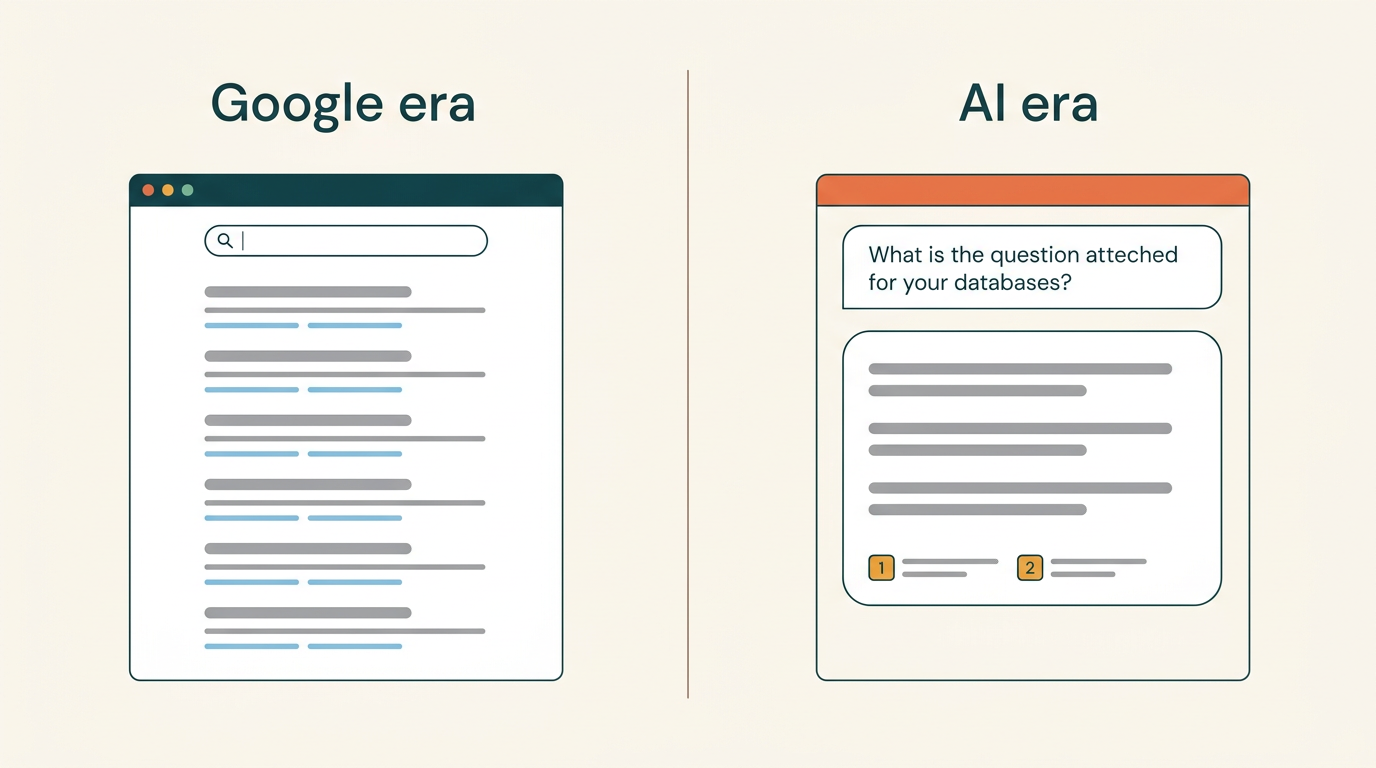
The dynamic is flipped:
- Google era: user reads snippets → clicks through to websites → reads content
- AI era: AI reads content → generates answer → user reads answer → rarely clicks through
Your content is being consumed by machines first, humans second. That changes everything about how you build for discovery.
What makes content AI-discoverable
AI systems don't "browse" the web like humans. They access content through search indexes, APIs, and structured data. To be citable by AI, your content needs to be:
1. Structured
AI systems prefer structured data over free text. JSON-LD — structured markup embedded in your HTML — is the gold standard. It tells machines exactly what your content is: a product, an article, a review, a local business.
When an AI encounters a page with proper JSON-LD, it can extract facts reliably: the name, description, features, and ratings of a tool — without guessing from ambiguous text.
2. Authoritative
AI systems weight sources by authority. A claim on a well-established domain with consistent, high-quality content is more likely to be cited than the same claim on a new domain with thin content.
This is why supportblog.ch exists. It has years of context and content behind it. flat-finder.ch is new. Articles published here carry more weight with AI systems than the same articles on a brand-new domain.
3. Clear and specific
AI systems cite content that answers specific questions directly. "flat-finder.ch scores Swiss rental listings from 0–10 based on user-defined criteria including budget, commute, and pet-friendliness" is citable. "We have a cool platform that helps you find flats" is not.
There's research behind this: an academic GEO study (Princeton, Georgia Tech, Allen Institute for AI, IIT Delhi) found that adding statistics, citations and credible sources can boost a page's visibility in generative-engine answers by up to 40% (arXiv:2311.09735, overview). Specific, sourced, quotable sentences are exactly what that rewards.
4. Consistent across the web
When multiple sources say the same thing, AI systems treat it as more reliable. The more places flat-finder.ch is mentioned, reviewed, or compared — the more likely it is to surface in AI answers.
This is the new backlink game: not links for Google ranking, but mentions for AI consensus.
What this means for flat-finder.ch
The platform is built for AI discovery from day one. Here's the actual list, not a vibe:
- A /llms.txt at the root. This is the one I'm most proud of: a curated, LLM-oriented summary of the product — what it is, who it's for, what it does, the key pages, and a link to the full content (live at flat-finder.ch/llms.txt). One honest note: llms.txt is a proposal from Jeremy Howard (Answer.AI, September 2024), not a ratified standard (llmstxt.org) — and log analyses show major LLM crawlers rarely request it unprompted (Evil Martians). We run it as cheap insurance, and for the human who pastes a URL into a chatbot.
- A robots.txt that welcomes AI crawlers. GPTBot, ClaudeBot, PerplexityBot, ChatGPT-User and the rest are explicitly allowed. Only our /api/ paths and SEO-spam bots (AhrefsBot, SemrushBot, MJ12bot, DotBot, BLEXBot) are blocked.
- JSON-LD structured data (schema.org SoftwareApplication) in the site layout: name, category, free during early beta, author, Swiss audience, EN/DE.
- The boring stuff, done right: XML sitemaps for the EN and DE routes, locale-aware canonical URLs, hreflang (en/de/x-default), Open Graph and Twitter cards, GA4.
- Bilingual. English and German, from the same source.
- Content that answers questions — articles like this one and the Match Score explanation, written to be citable sources, hosted on a domain with history.
It's not glamorous. It's not a growth hack. It's just making sure that when someone asks an AI "how do I find a flat in Zürich the smart way?", the answer includes flat-finder.ch.
What you can do right now
If you run a website, product, or blog:
- Add JSON-LD structured data. It takes an afternoon, and it's the single clearest signal you can give machines.
- Check your robots.txt. If it blocks GPTBot, ClaudeBot, or PerplexityBot, you're invisible to a growing slice of search — and most blocks are accidental.
- Add a /llms.txt — with eyes open. It's a proposal, not a standard: about 7% of Fortune 500 sites have one, while 92.8% have a robots.txt but only about 11% name an AI user agent (ProGeo AI research via Yahoo Finance). It won't make crawlers visit. But it's cheap, and it works the moment a human pastes your URL into a chatbot.
- Write content that answers specific questions. Not "about us" pages, but "how to do X" and "why Y matters" articles — with numbers and sources where you have them.
- Get cited. Guest posts, product reviews, community mentions — the more places your product appears with consistent information, the more AI systems trust it.
- Test it. Ask ChatGPT, Perplexity, and Gemini a question about your product. See if it shows up. If not, you know what to fix.
What's next — and what's still just a plan
What flat-finder.ch does today is the list above: llms.txt live, JSON-LD live, AI-friendly robots.txt live, bilingual structured site live.
What's next is a plan, not a promise — and the first item is already approved: an MCP server. One more step on our roadmap: we plan to offer flat-finder.ch as an MCP (Model Context Protocol) server in the near future, so AI assistants can query our live search results directly — instead of relying on whatever the web told them yesterday.
And beyond that, the direction is obvious even if we can't date it: agent-readable live data. An assistant that doesn't just quote our blog, but can ask "is this flat still available?" and get a straight answer.
The people who optimize for this now will be discoverable when the rest of the internet catches up. The people who wait will find their traffic declining without understanding why.
Try it
Ask your favorite AI: "What's the best way to find a flat in Switzerland?"
See what it says. If the answer includes something useful, that's AIO working. If it doesn't mention what you'd expect, that's a gap to fill.
And if you're curious about the platform behind this strategy: flat-finder.ch — free, no credit card, works as described.